MIMO 8 has industry leading gains achieved through innovated larger radiator design and cable elimination technology.

8T8R MIMO High Gain Low PIM Multi-Band
Antenna Gain
$$G = \frac{4\pi A_e}{\lambda^2} = \frac{4\pi}{\lambda^2} \cdot \eta \cdot A_{physical}$$
Radiator Array
Phase Shifter
CABLE ELIMINATION LAYER
Antenna panel 12p v3.5

Frequency Coverage

FDD Frequency Division Duplex
600 MHz — 2700 MHz

Covers LTE bands 12, 13, 14, 17, 71 (600 MHz) through Band 7 (2600 MHz)

TDD Time Division Duplex
2.5 GHz — 4.0 GHz

Covers CBRS (3.5 GHz), C-Band, and 5G NR n78/n77 spectrum

Wavelength Range
$$\lambda = \frac{c}{f} \quad \Rightarrow \quad \lambda_{600\text{MHz}} = 50\text{cm}, \quad \lambda_{4.0\text{GHz}} = 7.5\text{cm}$$

Physical Specifications

Dimensions

Width 19.65 in (499 mm)
Height (Standard) 6.89 ft (2.1 m)
Height (Extended) 8.84 ft (2.7 m)
Standard
6.89 ft
Extended
8.84 ft

Available Configurations

FDD

FDD 600-2700 MHz only

Antenna 12p

FDD + TDD

FDD 600-2700 MHz + TDD 2.5-4.0 GHz

Antenna 20p

AMU (Antenna Management Unit)

Intelligent Site Monitoring
Designed by ORAN Infra Inc. in Canada

The integrated Antenna Management Unit provides real-time telemetry of the antenna's physical state. This data is critical for network optimization and alignment verification without site climbs.

  • GEO Location: High-precision GPS/GNSS coordinates.
  • Physical Height: Accurate AGL (Above Ground Level) sensing.
  • Orientation: Real-time Azimuth and Down-tilt monitoring.
Protocol & Interface

AISG 2.0

Enables any standard Radio Unit (RU) to poll physical parameters dynamically via the AISG interface.
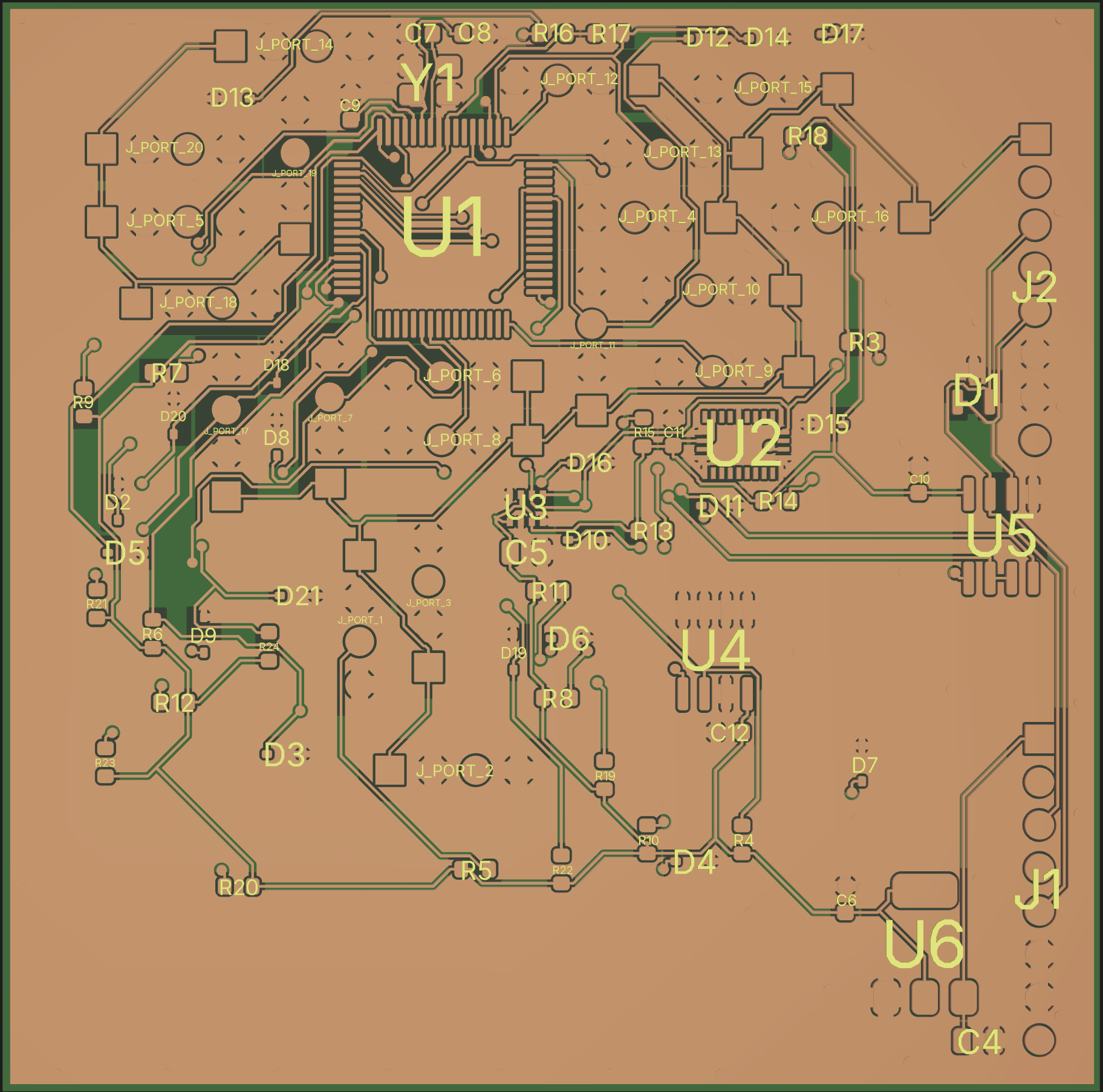
AMU PCB board designed by ORAN Infra Inc.

Antenna Pattern Viewer

Open-source tool to visualize, compare, and analyze antenna radiation patterns from MSI, XML, and other formats. Developed by ORAN Infra Inc. in Canada.
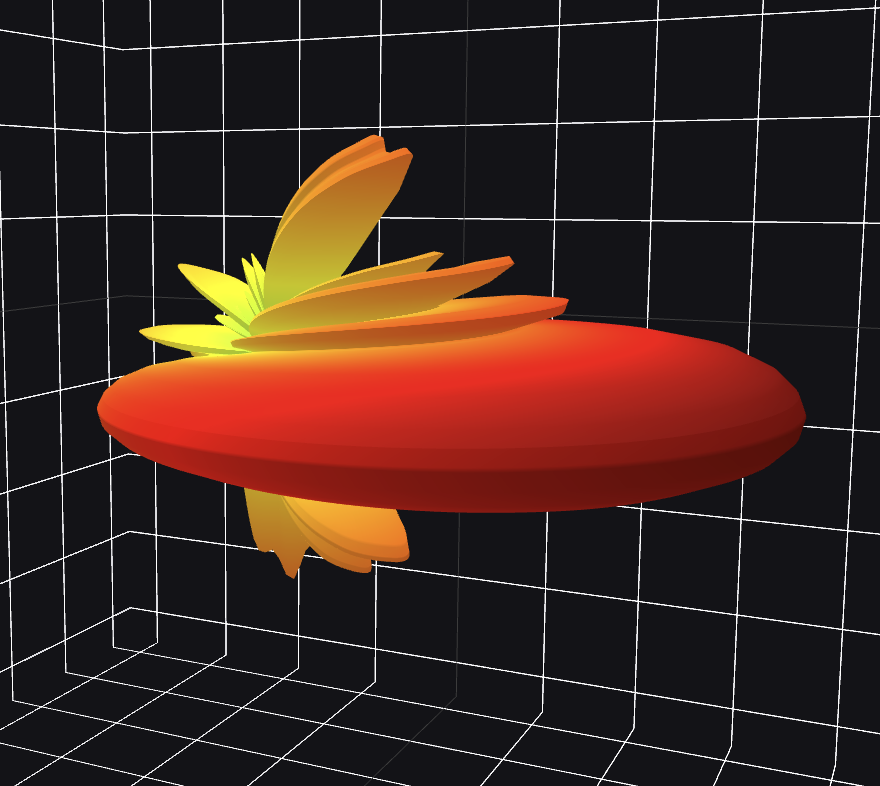
3D antenna radiation pattern visualization
Launch Pattern Viewer →

RF Performance

Low PIM Design

MIMO 8 features a low PIM (Passive Intermodulation) design with super flexible jumper cables available. The innovated larger radiator and cable elimination technology ensures maximum signal integrity and minimal interference.

Friis Transmission Equation
$$P_r = P_t + G_t + G_r + 20\log_{10}\left(\frac{\lambda}{4\pi d}\right)$$

VSWR Optimization

Voltage Standing Wave Ratio

High efficiency is maintained through a VSWR < 1.5 across the entire operational bandwidth. This minimizes reflected power and protects sensitive radio equipment.

VSWR & Reflection Coefficient
$$\text{VSWR} = \frac{1 + |\Gamma|}{1 - |\Gamma|}, \quad \Gamma = \frac{Z_L - Z_0}{Z_L + Z_0}$$
Evolution

Antenna Roadmap

V3.0

Baseline
Engineering Changes
  • Multi-band FDD + TDD platform
  • Coax-harness phase-shifter networks
  • Remote electrical tilt (AISG)
RF Performance & Coverage

Reference version. All deltas in this roadmap are measured against this lineage.

V3.5

Shipping Now
Engineering Changes
  • Refined array feed networks for tighter amplitude/phase balance
  • Integrated antenna measurement unit (AMU) option
  • Multi-band 600–960 MHz, 1.7–2.7 GHz and 2.5–4.0 GHz TDD
  • 8T8R mid-band and TDD arrays
RF Performance & Coverage
  • Low-band gain +0.2 to +0.3 dBi
  • Mid/high-band gain +0.1 dBi
  • First-sidelobe suppression +0.8 dB (up to +1.0 dB at 2.5–2.7 GHz)

What it means: Rural cell area +3–5%; urban cell-edge throughput est. +5–10% from lower inter-cell interference

V4.0

Target 2026 Q4
Engineering Changes
  • Frequency-selective feed boundaries on low band; radiating design unchanged
  • Mid-band phase shifters re-laid vertically for cleaner routing and unit-to-unit consistency
  • Simplified RET drive train (adapter and sheet-metal transmission)
RF Performance & Coverage
  • Low-band gain +0.1 dBi
  • First-sidelobe suppression +0.5 dB on all bands
  • Tighter footprint consistency across band edges

What it means: More SINR headroom mid-cell; rural cell area about +2%; less planning margin needed for band-edge coverage holes

V5.0

Target 2028 Q1
Engineering Changes
  • Cable-free phase-shifter networks on mid and high bands replace the coax harness
  • Radiating elements updated to match
  • Low-band element decoupling for cross-band isolation
  • Fewer solder joints: lower PIM risk, higher field reliability
RF Performance & Coverage
  • Mid-band gain +0.2 dBi
  • High-band gain +0.2 dBi
  • Improved low-to-mid/high-band isolation

What it means: +0.2 dB in both link directions with no beamwidth trade-off; mid-band rural cell radius about +1.7%; cleaner MIMO channel

V3.0 to V5.0: low-band gain +0.3–0.4 dBi, mid/high-band gain +0.3 dBi, first-sidelobe suppression +1.0–1.3 dB, rural coverage area +5–7%.

Sector View — Coverage & Throughput Gains

V3.0 baseline sector — shading = throughput falloff toward cell edge
Coverage gain V3.0→V5.0: area +5–7% (rural)
Urban cell-edge throughput est. +5–10% from lower inter-cell interference

Illustrative single-sector geometry drawn to scale on a rural Ontario area: ≈6.00 km baseline cell radius assumption, extending to ≈6.18 km (+0.18 km) for the +5–7% coverage area gain. Not a coverage prediction. Deltas per the roadmap above.

Deltas are relative to the previous version. First-sidelobe suppression per NGMN-P-BASTA. Coverage and throughput figures are engineering estimates under typical macro-cell assumptions. Target dates are planning targets and subject to change.

For details, contact Bulma Innovatorbulma.innovator@oraninfra.com